Amazon ranks 14th of 4,706 sources — 56,090 citations across 850 books and 16 genres.
When AI assistants recommend books, they draw from reference, community and specialist sources. Amazon, the world's largest bookstore, ranked 14th.
This is the original dated study (850 books, three engines: ChatGPT, Gemini, Perplexity). For the continuously-updated figures — now across four engines (ChatGPT, Claude, Gemini, Perplexity) and growing daily — see the live AI Book Discoverability Index →. The live data moves (Amazon currently ranks around #13); the pattern below is unchanged.
When you ask ChatGPT, Gemini or Perplexity to recommend a book, they build the answer from reference and community sites — not from shops. Across 850 books in 16 genres, we counted all 56,090 citations across 4,706 distinct sources. Wikipedia ranked first with 3,642 citations; Amazon — the world's largest bookstore — ranked 14th with just 481. To be recommended by AI, a book has to exist on the sites AI trusts, not only on its Amazon listing.
Where AI's book recommendations actually come from
We logged every source ChatGPT, Gemini and Perplexity cited as they recommended books — 56,090 citations spanning 4,706 distinct sources. Ranked by citation count across all 850 books — top 14 shown:
Citations across 850 books × 16 genres × 3 engines (ChatGPT, Gemini and Perplexity). Top 14 of 4,706 sources shown. June 2026.
Publishers out-cite every retailer
The most-cited commercialsites aren't shops at all — they're publishers' own domains. Penguin Random House (1,306) and Pan Macmillan (1,185) are each cited more than twice as often as Amazon (481).
Citations to publisher vs retailer domains · 850-book set · June 2026.
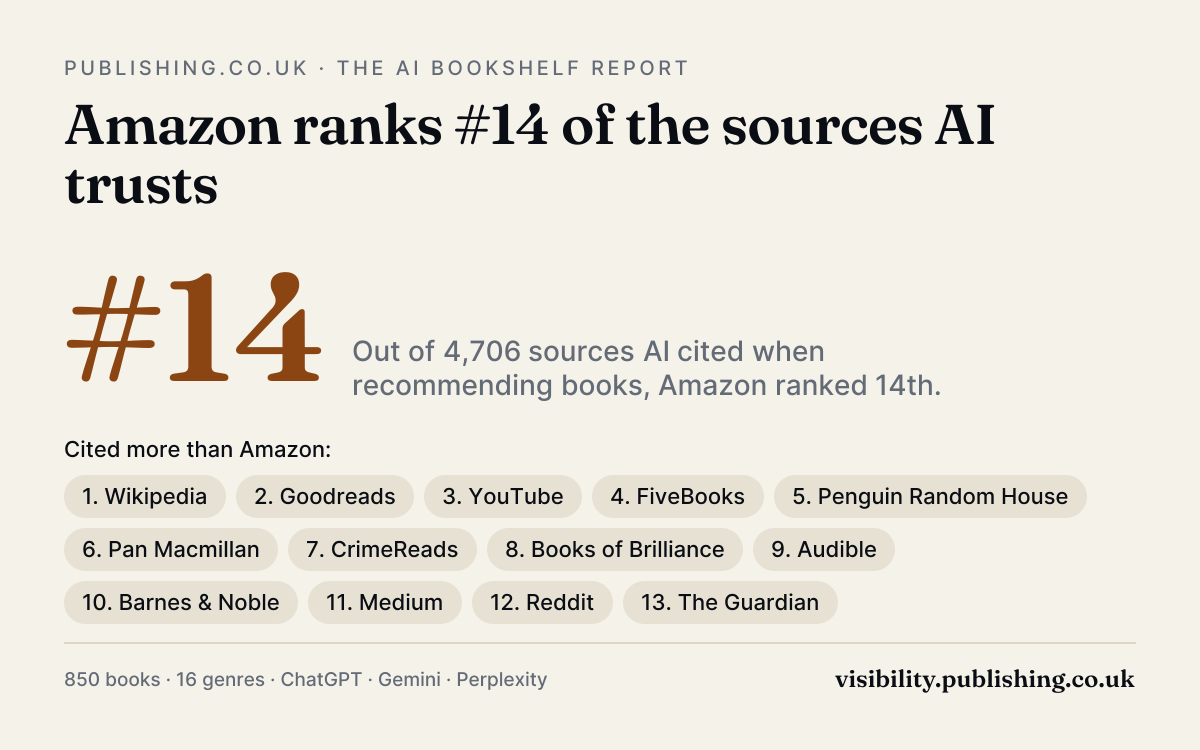
Graphics (850 books, 3 engines) — free to republish with credit + a link back.
The three pillars: reference, community, video
AI doesn't recommend books from a shop window. It recommends them from the open, structured, well-linked corners of the web:
Wikipedia is the spine
Wikipedia was the single most-cited source and the only one to appear across all 16 genres. A book (or author) with a solid, well-sourced Wikipedia presence is far more “knowable” to a model than one without.
Goodreads and YouTube carry the conversation
Goodreads (3,297) and YouTube (2,096) sit just behind — the models lean heavily on community reviews and creator video. Where readers talk about and film books, AI listens.
Amazon is a shop, not a source
At just 481 citations and ranked 14th, Amazon behaves the way the models treat it: a place to buy, not a place to learn what's worth recommending. Optimising only your Amazon listing leaves you invisible to AI discovery.
Some genres are far easier for AI to recommend
Not every shelf is equal. We measured how readily the models actually name a genre's books — publishing.co.uk's AI Discovery Score (0–100) — and averaged it across each genre. The spread is wide. Even the most AI-visible shelf, personal finance, averages just 54/100; the hardest, crime thrillers, averages 28. A personal-finance author is roughly twice as likely to be named by AI as a crime-thriller author asking the same kind of question.
Average AI Discovery Score (0–100) per genre · selected rows from the 16-genre table · June 2026.
The niche kingmakers
Beyond the universal giants, each genre has a source that punches far above its weight — one site AI turns to again and again for that one shelf. The striking part is how concentratedthey are: for most of these, nearly every citation the model gave them landed on a single genre. Get featured here and you're talking directly to the model's source list.
Each genre's kingmaker, confirmed at scale
With 850 books across all 16 genres, the per-genre patterns are sharp. The single source AI reaches for first in each shelf:
Nearly every time AI cited the ALA, it was naming a young-adult title. The library establishment quietly shapes the YA shelf. (n=110 citations)
AI's default for business books: 96% of HBR Store citations landed on the business shelf — almost a pure-play kingmaker. (n=133 citations)
A specialist sport-science press. Every single one of its AI citations landed on the health-and-fitness shelf. (n=87 citations)
A niche SFF magazine most readers have never heard of — and AI's most over-indexed source for epic fantasy. (n=149 citations)
A personal-finance media site, not a bookshop — and 100% of its AI citations were for money books. (n=90 citations)
A single cookery newsletter the models reach for first when recommending cookbooks — wholly concentrated in one shelf. (n=62 citations)
Companion study: 188-book / 4-engine dataset
A separate study covering 188 books across 4 engines (adding Claude to the mix) found an even sharper ratio in less well-known titles — Wikipedia cited 16 times more than Amazon. Across both studies, the range is 6–16× depending on title fame.
We logged every source the four models cited as they recommended books — roughly 21,900 citations in total. Ranked by how often each source appeared:
Total citations across 188 books × 16 genres × 4 engines (ChatGPT, Claude, Gemini, Perplexity). Preliminary, June 2026.
What this means for your book
AI discovery is winnable — but the work happens off Amazon. Based on the data, the highest-leverage moves:
- 1Become knowable to Wikipedia. A well-sourced author or book page is the closest thing to a master key for AI visibility.
- 2Own your Goodreads presence. Complete profile, real reviews, correct metadata — it's the community layer AI reads.
- 3Get on the lists AI trusts. Pitch the curators (FiveBooks) and your genre's kingmaker rather than chasing Amazon ranking alone.
- 4Show up in video. A book mentioned on YouTube — BookTube, interviews, trailers — feeds a channel the models lean on heavily.
How we ran this
publishing.co.uk probes the AI assistants readers actually use with the questions readers actually ask, then records which sources each model cites. This report aggregates that data across our curated genre set.
- Prompts
- The questions readers actually ask — “best [genre] books”, “books like X”, “a good [genre] novel” — run in web-grounded mode. We logged every source each model cited while forming its recommendation. Each book was probed with 12 reader-style prompts per engine. Each prompt was run once (single-pass; figures are directional at scale, not averaged over repeated runs).
- What “cited” means
- A source the model drew on to decide what to recommend — not“where to buy”. Retail links appear, but they’re a small fraction of the recommendation-authority sources we count. That distinction is the whole point of the Amazon finding: Amazon is where readers buy, not where AI learns what’s worth recommending.
- Headline set
- 850 books × 16 genres × 3 engines(ChatGPT, Gemini, Perplexity). Every “Amazon ranks #14” / “56,090 citations” figure comes from this set. Wikipedia-vs-Amazon gap on this set is ~6–8×.
- Companion set
- 188 books × 16 genres (≈12 each) × 4 engines(ChatGPT, Claude, Gemini, Perplexity). Every “16×” / Wikipedia-2,200 figure comes from this set. The sharper ratio reflects less-famous titles where AI leans harder on reference and community sources. Every figure is labelled with the set it came from, so the two are never conflated.
- Filtered
- Spam/dead domains and non-book / marketplace noise removed (≥2-book trust gate).
- Dated
- Headline dataset: June 2026. Companion dataset: June 2026. AI answers shift run to run; figures are frozen on publish and re-locked as the dataset grows.
- Reproduce it
- Run the same prompts in web-grounded ChatGPT, Claude, Gemini or Perplexity — the same kinds of sources surface. The per-genre kingmakers are checkable in minutes.
- Run by
- publishing.co.uk, the AI book-visibility tool. Full per-book scoring rubric: how the AI Discovery Score is computed.
Share the findings
All six graphics are free to republish with credit to publishing.co.uk and a link back to this report. Click any graphic to open it full-size, then save or embed.
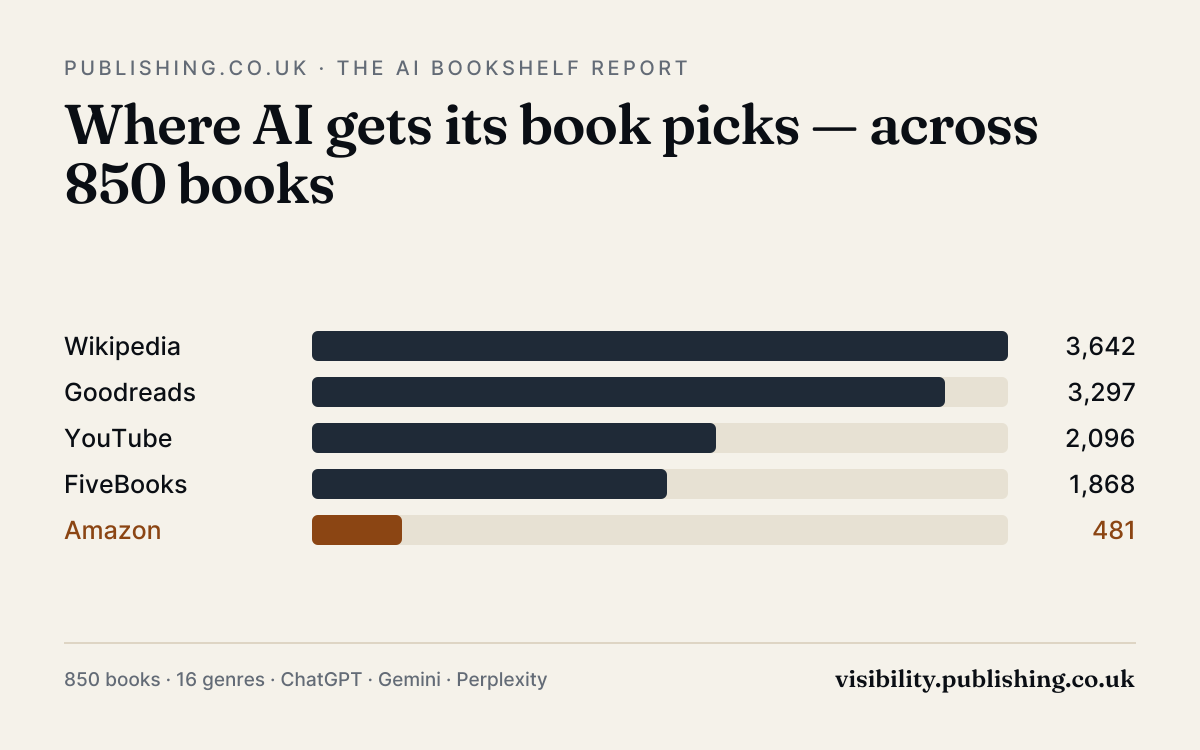 Where AI gets its book picks (not Amazon)
Press enquiries and the full dataset: publishing.co.uk.
Frequently asked
How does AI decide which books to recommend?
It doesn't read your sales page — it assembles an answer from sources it trusts. Across 850 books and 56,090 citations, the dominant sources were Wikipedia (3,642 citations), Goodreads (3,297) and YouTube (2,096). A book that's well represented on those sites is far more likely to be named than one that exists only on Amazon.
Does Amazon matter for AI book recommendations?
Far less than most authors assume. Across 850 books, three AI engines cited Amazon just 481 times — ranking it 14th of 4,706 sources. A companion 188-book/4-engine study found a 16× gap vs Wikipedia. Amazon is where readers buy; it is not where AI learns what to recommend.
How do I get my book recommended by ChatGPT?
Build presence on the sources AI cites: a well-sourced Wikipedia page, a complete Goodreads profile, placement on curated lists (FiveBooks and your genre's specialist site), and mentions in video. See the four-step checklist above.
Which AI models were tested?
The headline 850-book study covered ChatGPT, Gemini and Perplexity, all with live web access. A companion 188-book study also included Claude. Amazon's Alexa for Shopping is being added to the publishing.co.uk live tool, after which we'll publish an updated edition.
Can I see how AI sees my own book?
Yes. publishing.co.uk runs the same probes against your specific title and shows which engines name it, at what list position, and which books win instead. Start with a free check.
See how AI sees your book
publishing.co.uk asks the assistants what readers ask — and shows you exactly where your book stands, and how to climb. Free to start.
Run a free AI visibility check →Headline figures from the 850-book / 3-engine dataset, June 2026. Companion figures (16×) from the 188-book / 4-engine dataset, June 2026. Figures are drawn from publishing.co.uk's live citation data and re-locked with a dated methodology note as the dataset grows. Not affiliated with or endorsed by OpenAI, Anthropic, Google, Perplexity, Amazon or Wikimedia.